
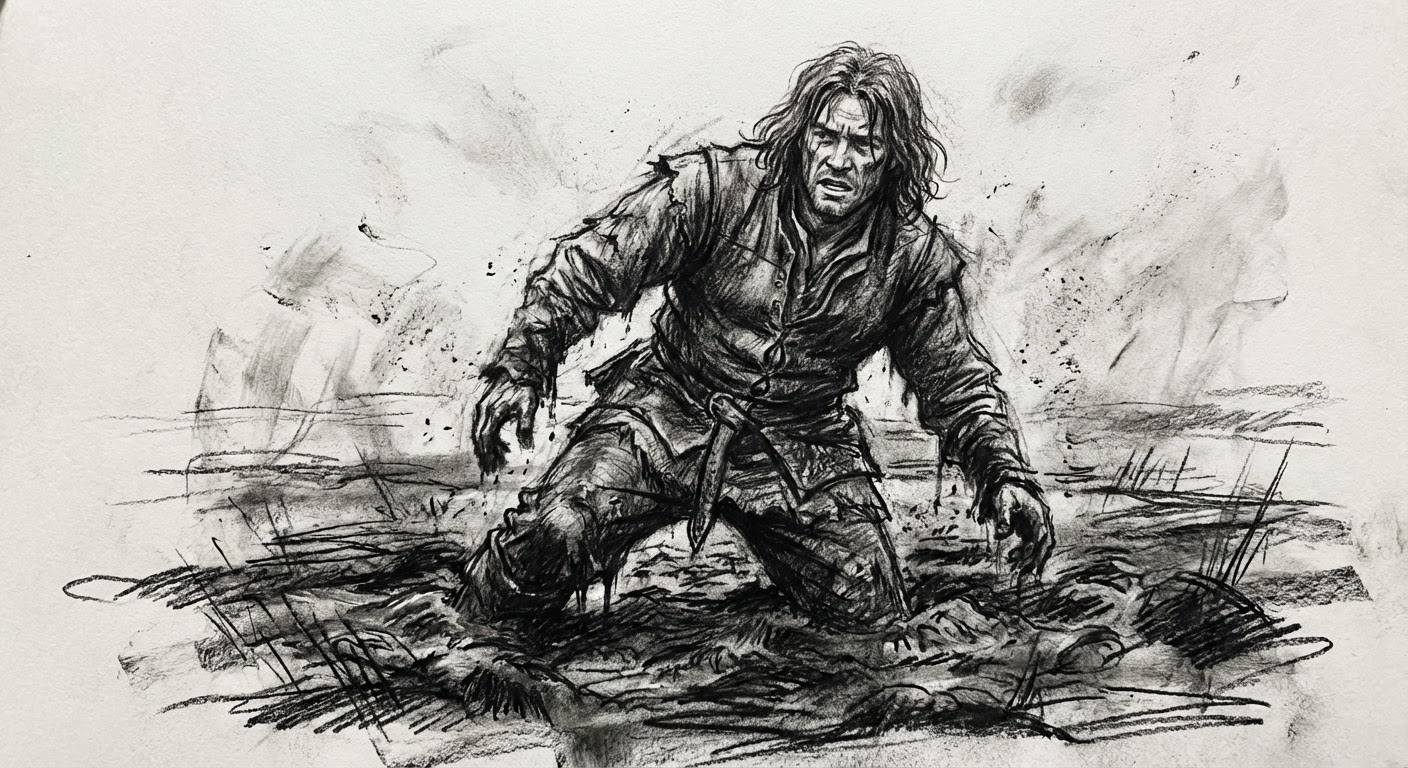
Lukas was a quiet teenager whose forest-green eyes held the nervous shimmer of first love. He had learned the foxtrot specifically to lead Alva away from the prying eyes of their village, creating a sanctuary where a single glowing butterfly—a luminous blue secret—revealed the magic within her. To a Narrative Analyst, Lukas embodies the Archetype of the Loyal Sentinel, a man whose entire identity is anchored in that celestial promise, even as the world sought to erode it with blood and ash.
Fifteen years later, that gentle boy has been replaced by a scarred veteran known as the Witch Hunter. His journey is a masterclass in how a single choice can redefine a life path, transforming a boy of “quiet strength” into a weary hunter chasing the ghost of a girl who vanished to become a wife and mother named Clara, before finally descending into the darkness of the mountain.

Loyalty Beyond Reason
Lukas’s steadfastness is his defining narrative anchor. While others might flee the uncanny, Lukas’s loyalty is a gravity that pulls him toward the flame, regardless of the heat. This trait was forged in the trauma of his youth when Alva’s magic first curdled into something “menacing.” When his beloved pet, Bear, was murdered by village bullies and reanimated as a jerky, skeletal horror, Lukas did not renounce his love. He stayed, choosing the girl over the safety of the status quo.
“But Alva knew that Lukas, with his quiet strength, was the kind of boy who grew into the man you stayed with forever… a husband, a friend, a bear to fight the world.”
This loyalty is what turned a gentle boy into a hunter who spent fifteen years chasing a shadow. From a literary perspective, this is the burden of the sentinel: he protects the memory of the person he loved, even as the reality of that person morphs into something unrecognizable.

The Field Guide to a Broken Heart
Lukas’s vocation as a “Witch Hunter” is a profound narrative irony. He became the world’s foremost expert on killing the very creatures he wished to protect, using the title as a desperate research methodology. His search for the woman who lived for a decade as “Clara” was documented in a physical manifestation of his obsession.
The artifact of this search is Luka’s Field Guide of Witches in The Erstlands. The book itself is a symbol of a heart frozen in time—its leather cover worn, its pages filled with charcoal-smudged sketches and meticulous categorizations of Root Witches and Storm Callers. Each entry was a waypoint in a map of grief. He donned the mask of a “barbaric” killer to gain the access necessary to track the specific “yellow” magic of his youth, illustrating how identity can be weaponized in the service of a singular, desperate goal.
Vision Through the Scars
The physical transformation of Lukas is etched into his visage, a literal mapping of the cyclical trauma inherent in his quest. An encounter with a Shadow Witch left his forehead fissured by a fireball and one of his forest-green eyes lightened by four shades. This “limited vision,” however, became a “focal lens.”
Analytically, these scars represent a narrowing of the soul. Lukas used the damage caused by one witch to become more proficient at hunting others, all to find a third. Unlike Roderick (Cinder), who was blinded by bitterness, Lukas maintained a “pure light” of love. His scars did not obscure his vision; they refined it, allowing him to maintain the “Sentinel” archetype while more fragile men succumbed to the void. He is the man who sees the world through the damage the world has done to him.

Seeing the Soul Behind the Monster
Perhaps the most tragic lesson from Lukas’s arc is the ability to recognize an essence despite a multi-generational legacy of corruption. The magic Lukas finds on the mountain is no longer the “spring green” or “yellow” joy; it is the “venous ochre” and “crimson” of a soul in decay.
One must note the evolution of the threat: Alva is a fading engine of regret, while her daughter, Lily, is the true innovator of the “copper-skulled” abominations. Lukas’s growth is found in his ability to distinguish between the girl who made “soft and gentle” butterflies and the “Witch of the Mountain” who now presides over a factory of horrors. He understands that while Lily uses trapped butterfly souls and copper to create monsters, the original “yellow” sparks of Alva’s innocence still exist somewhere beneath the metal and the bone.
A Complex Moral Arc
Lukas’s relationship with Roderick (Cinder) highlights a complex moral landscape where justice is never clean. Roderick, a man whose skin is a weeping map of scabs and “fish custard” ointment, represents the “victim” who created the monster. Roderick’s own cruelty and bullying “brought out the evil” in Alva, proving that the monsters we hunt are often birthed by the society we are sworn to protect.
Lukas recognizes the “horrors” of Alva’s basement—the “room of horrors” where boys are hung by their hands, their life force harvested to power Lily’s creations. He is a protector who understands that Alva has become both a savior to a village of independent women and a nightmare to the victims she harvests. His arc concludes with the heavy realization that the girl he sought has become the very thing he is professionally obligated to destroy.
The Final Gaze
As Lukas stands before the cabin on the mountain, he is facing the wreckage of “Clara,” the mother, and the engine of the “copper-skulled” nightmare. His fifteen-year search ends in a confrontation with a soul-harvesting factory. His journey is a testament to the endurance of obsession and the grace required to see light in the center of an abomination.
If the person you loved became a monster to survive, would you have the courage to hunt them, or the grace to see the light they left behind?
