
The ‘Silly Stigma’ is what got me going on the quest for this book. It’s a feeling I have felt since I started thinking about the first book I published a few years ago, The Duct-Taped Dead. It’s also the book that got me fired, but that’s a story for another time.
The ‘Silly Stigma’ comes from the idea in my head that what I do is, well, silly. If you ever sit and listen to other people’s conversation (which I often do, when I’m at the coffee shop), everyone is incredibly serious.
They talk about deadlines for quarter reviews, reports, or their endless quest in squash and trail running. They enjoy these things, even if they didn’t. Because the truth was, if they didn’t enjoy it, they wouldn’t do it. Even the reports. It brings a sense of drama to their lives.
I know of a woman, older than me, who does payroll. She does practically nothing all month, but in the last week, she’s chaotic. Every end of the month, it’s like a surprise to her that she is so busy. She rages about it. Complaining about how Sarah forgot that invoice, and Jason forgot that tax input in the system. She secretly loves it. She loves that employees have to phone her and plead with her to extend a deadline if possible, because they forgot their paperwork. Makes her feel like she’s in power. But then, for three weeks, she gets to drink piña colada on the beach and not be part of the day-to-day drama.
This is the life of the conventional.
So when creative people start doing research into Zombies, or Werewolves, or write stories about children doing magic, you can see how it might feel silly in comparison. I’ve often been asked what I am writing or working on, and then I shrug it off and change the conversation. Why? Well, because it makes me feel silly and like what I’m interested in isn’t as serious as what other people do. It feels, perhaps, immature. Like a child’s drawing next to the Mona Lisa. It also feels like a waste of time. I’m playing in a world that doesn’t exist while they are creating solutions for reality. It feels like I’m not contributing. And it gives me feelings of embarrassment. Which I know I shouldn’t have, but it’s like I’m spending all day in my imagination, when they are working in spreadsheets. There is a guilt about it.
A family member has been ranting for twenty minutes on the bad infrastructure systems he has to deal with within the Justice Department, and how ‘Kathy’ has been hounding him for a presentation on the Predictive Text Analysis from Quarter 4 and its implications on the ROI of Next Year’s Financial. Then, after that, they want me to share how I finally worked out how I was going to kill all the scientists in my book Second Earth by putting them in a bunker, under a volcano.
Yes.
It feels silly.
But it also feels fun.
And this is what creatives need to remember. This is what artists need to remember when putting paint to canvas, or writers, tapping on keyboards. The truth… the very essence and truth of it all, is that, given the choice, those people concerning themselves with ICP breakdowns for Marketing Strategies, would really, actually want to do what we do.
There, I said it.
They would. Honestly.
And they say they would as well, then follow it up with ‘If I were brave enough.’
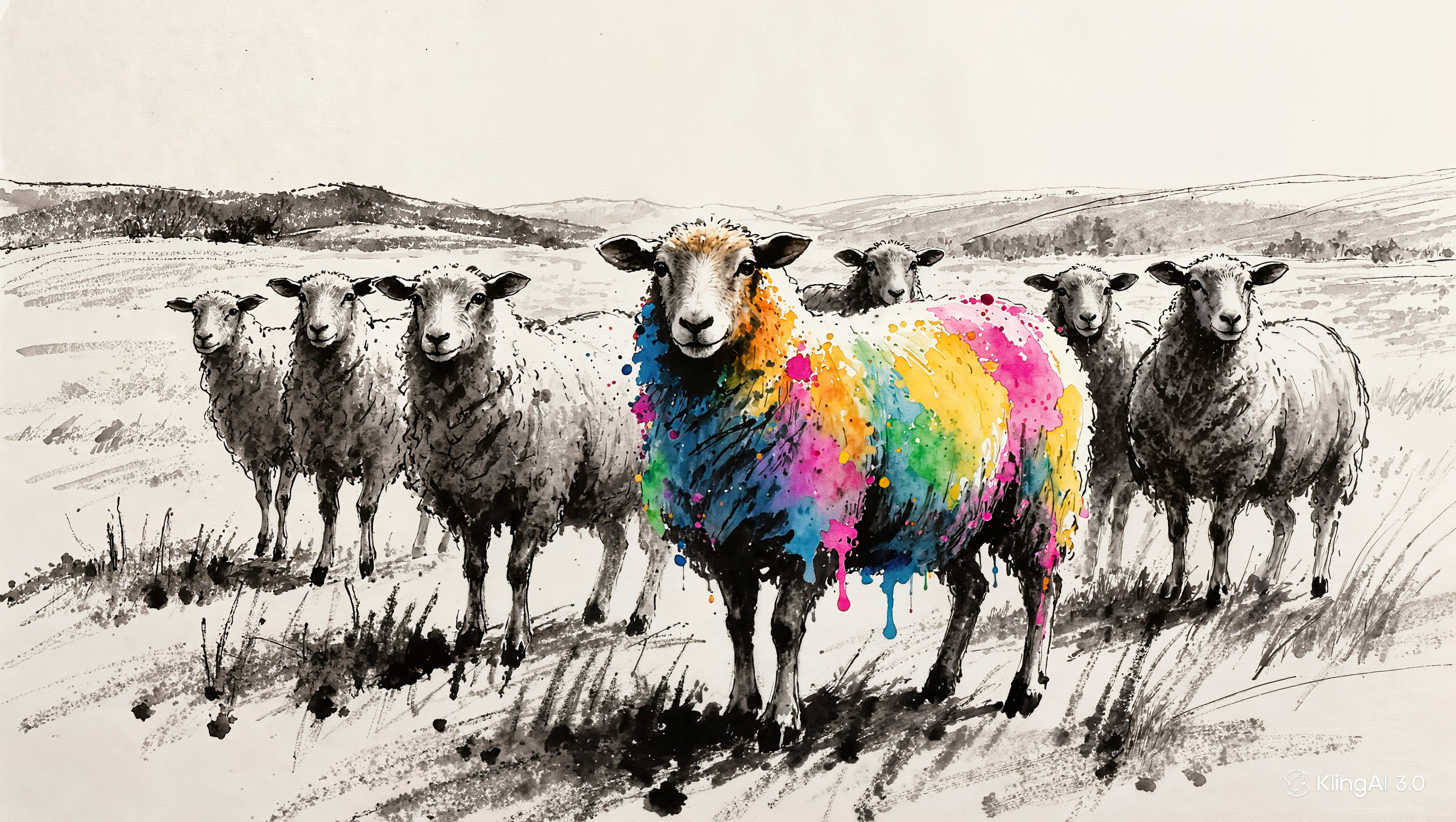
But that’s the real reason. I’m afraid I’m going to be harsh here. The truth is, most Susans in accounting can’t spend a day researching different witches’ tiers or world-building space stations, because the truth is, they are just regular, good old-fashioned sheep. They are not multicolored in any way, type, or form. They cannot even comprehend what it is that you do, or how you came up to do it in the first place.
And that’s fine. It really is. It’s nice to meet different kinds of people. Especially for writers and artists, because we can do characters based on the (to be truthful) dull people we know. Computer games wouldn’t be fun without the Non-Playing-Character (NPC). And that NPC is based on the gamer writer’s friend Steve. Who is funny, but is incredibly, well… Standard. Just a standard person. Out of a box.
And the truth is, most people don’t know they are standard people. I’ll tell you something else, they really, really don’t like it when you point it out to them either.
I’ll admit, when I was in my twenties, I used to categorize people. I would meet people at parties, work, and other social places, then practically interrogate them to find out what made them tick. I lost a lot of friends this way, but it was a process I had to go through to find out what the different types of ‘standards’ there were, out there in the world.

I remember, when I waitressed, we had this girl who got a job as a hostess type thing, for a few weeks. Think her name was Georgie, or something along those lines. She basically came into the city by yacht. That’s right – she sailed in. She had no place to stay, no job, nothing. A backpack was all the woman carried. She managed to find a friend to bunk with, and then walked down the street and got a job as a hostess with us. She was with us for probably about two months before she heard about a yacht going somewhere else, in need of someone to do, I guess, bits and bobs, since she didn’t really have any skills, and off she went. In that time period of working with us, she didn’t pay rent, she didn’t buy furniture, and she dated one of the waiters with no intention of being with him longer than she had to.
She was the complete opposite of the pressures I felt at that age. I envied her wandering abilities as I worked towards a better credit score.
One evening, though, the diner was fairly empty, and so I started asking her questions. I had to. I needed to understand how she managed to do what she did, because one day I knew I was going to need this information. I was going to need the understanding of what it took to be a person with no pressures of society and no concern for tomorrow. To view life as a day-by-day adventure, with the sole belief that everything would work out in the end, no matter how you spent today.
After about twenty minutes, she snapped at me. I was making her uncomfortable. Of course I was. This was a woman who kept her cards close to her heart. But it also made me realize that perhaps the cost of how she lived her life was the constant judgment. It didn’t matter if the judgment was positive, like mine, where I was inspired by her, or if the judgment was negative, like maybe some grouch would have about her lack of concern for responsibility or tax liability. Either way, living outside the box, externally (as opposed to writers and creatives who do it internally), meant that you were free, but also a source of conversation.
And so there it was.
When the day comes, and I have a character who is wild and free, I’ll remember that while most moments they are, they are also constantly living with the awareness that they are being judged for it. And that has its own toll, whether they are willing to admit it or not, at some level or degree.
But that same judgment that the feral live with on their sleeves, we live internally. We can hide better amongst the conventional, until we are asked that frightful question, “What are you writing?”
The good news is that most writers have a day job. It often is in marketing, but it can also be in project management or publishing. But it is there. And we can hide behind it so that only the very innermost circles know the truth about our personal thoughts. Only the trusted are aware that when we look at the wall for five minutes without blinking, it’s because we are troubleshooting our next plot or figuring out our next dialogue. That is the reason why writers shower longer than engineers, because the shower is one of the few places in the house where we get to actually act out or converse physically with invisible characters in our heads, without being watched.
Don’t deny it. I know I’m not the only one.
But I am digressing. I need to get back to my point, which is that being a multicolored sheep does make you different, yes. But it also makes you interesting. And the truth is, boring people wish they were interesting. Most of them have fooled themselves into thinking they are special. They paint-by-number flower vases and make quilts from pre-made kits of square fabric and instructions, and say it’s creative. And we have to go ‘ooh’ and ‘aah’ over it, like it is, but it isn’t. Not really. It’s more like they are inspired to be creative. They have put the hours in, yes. They have mastered the technique of oil paints, or taken time to learn about stamps for their scrap-book journals, but it’s not really the same as when a writer conjures up dragons and spectacular beasts that allow their heroes to soar over the dunes of another planet.
They are more hobby artists. And again… that’s fine. But they are not multicolored sheep. And we know this because they don’t hesitate when someone asks them about it. Oh, they might be a little shy, because they know it’s not really creative, it’s just a bit of fun, really. But it’s not like a writer who, upon telling their thoughts, feels incredibly vulnerable and exposed. Because we know we are different. We know we are not the same as the others, and because inner worlds are so easy to hide, we are not as used to sharing them with the world, like my co-worker, Georgie, is.
But I am here to tell you that, regardless of the reactions people might have to you and your worlds, or story lines, it’s not silly. It’s a calling. It’s a gift that others wish they had. Even if there is a negative story, it is usually because of jealousy. Or perhaps, often, might have been born a multicolored sheep themselves, but then gave up on it, because it’s hard. It’s challenging. Walking a path that isn’t often walked is always difficult.
Even though they have been many, many writers before and many writers now (in fact, Google tells me there are over 100 million people working in writing-related roles), and the truth is storytelling is one of the oldest professions (next to prostitution – which is a very different profession, but it is interesting that essentially Netflix and Chill has been paired together longer than we thought). And yet, compared to the adults of the world, it feels like a new path for all of us. Unless you’re born into it, like Stephen King’s son or something. But for the purpose of being dramatic here and making my point, I’m going to pretend those people don’t exist and talk about being a writer as a unique path for all of us.
So I plead to you to be brave when you are at that next dinner with family or friends and be honest. Tell them, with confidence, about how you slayed that giant and how you spent three days working out how to formulate your flora. Because it is a talent that you are able to do, and very few others can. It requires, actually, a streak of dedication to be a writer and to spend so many hours in research and exploration. We are constantly observing the world and learning new things, in case it provides a backdrop or an understanding of something we need in a story. It requires, probably (don’t quote me here), but more troubleshooting skills than I would see even a senior coder would have. That might be a bold statement, but I feel like it’s the truth. I’ll tell you why: a coder fixes a bug in a system someone else built; a writer has to build the physics, the biology, the sociology, and the character arcs of an entire world—and then fix the bugs when the plot stops making sense. It’s “Troubleshooting the Impossible.”
Fly your freak flag, as they say. Or embody your multicolored wool. You are different. As challenging as that might be on some days, it is also something that defines you, and the more you allow it to be free, the more it can change your life and give you a journey of exceptional color and passion.

Being the Multicolored Sheep
This blog post is part of a larger project – Being the Multicolored Sheep – which will be a collection of posts, research, thoughts, and insights of being a creative, eccentric writer and the challenges that come with it. It will be a conversational (as you can tell from above) book, for fellow writers to be able to know that they are not alone.
But most importantly, to feel supported. A must-have for anyone who has the self-awareness to realise they are a walking, breathing enigma to the common Dave in accounting. If you question individuals to help with your next character profile, rather than to make friends, then this is a welcome book to your tribe.