
In the narrative architecture of The Dance Between Us, magic is not presented as a whimsical flourish but as a catastrophic disruption of the natural order. Central to this descent is a physical mnemonic anchor: Luka’s Field Guide of Witches in ‘The Erstlands’. This artifact serves a dual purpose, functioning initially as a private sanctuary for a boy’s grief and eventually as a clinical manual for a hunter’s survival. It documents the transition from a “boy who danced under the stars” to a man who meticulously quantifies the unnatural to stave off madness. The journal is the thematic bridge between young love and the traumatic emergence of a world where butterflies no longer represent beauty, but corruption.

The genesis of the journal is rooted in the fractured reality of Chapters 1 through 3. Lukas’s transformation was triggered by Alva’s unintentional descent into witchcraft—specifically, the horrifying reanimation of his dog, Bear, whose bones crackled into a bipedal monstrosity to slaughter village bullies. The subsequent fire and the perceived death of his peers forced Lukas into a life of nomadic vigilance.
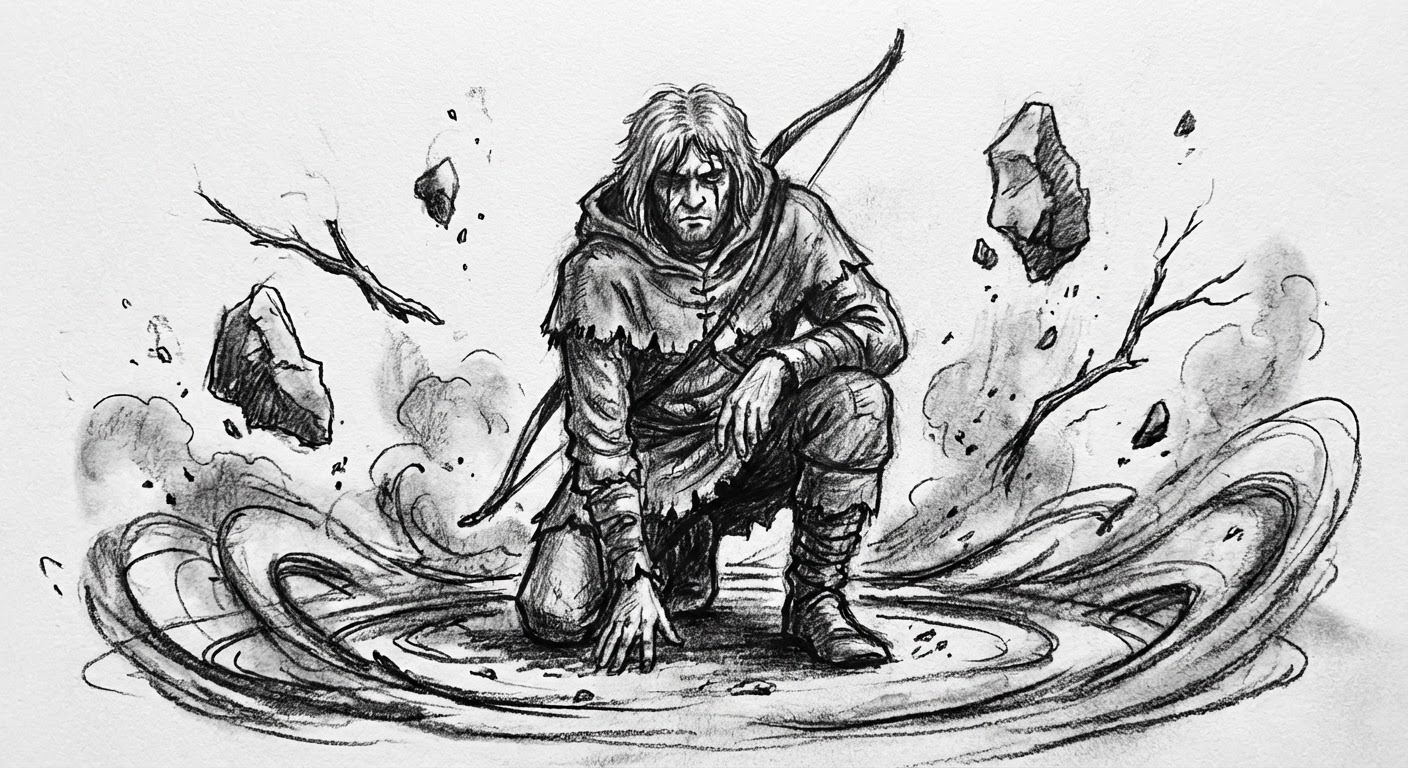
To manage this “thick darkness,” Lukas turned to the act of recording. As described in Chapter 8, the physical presence of the journal reflects this grit; it is a weathered leather book stained with charcoal smudges from lonely campfires. By sketching the horrors he encounters, Lukas employs a “focal lens” to translate magical trauma into a structured, manageable reality, effectively using clinical dissociation as a defense mechanism against his own memories.

The Taxonomy of Witches
Lukas’s field guide serves as a technical record of the Erstlands’ deteriorating ecosystem. The following taxonomy reflects his “Lessons Learned,” categorized by biological identifiers and environmental resonance.
The Witches of the Erstlands
| Witch Type | Defining Characteristics/Magic | Location Encountered |
|---|---|---|
| Storm Callers | Manipulation of air and wind; ability to summon atmospheric chaos. | The open lands of the Erstlands. |
| Bone Witches | Power over decay and reanimation; associated with the preservation of the dead. | Deep marshes and hidden graveyards. |
| Root Witches (Hedge Witches) | Ability to animate roots; identified by dark, sap-like blood and veins connected to the grove. | Milkwood and oak groves (e.g., Alisha). |
| Shadow Witches | Practitioners of psychological warfare; extraction of deep-seated fears and illusions. | The edges of the scorched lands. |
| White Witches | Potential for explosive magic (internal combustion) and wraith-like manifestations. | The forest near Yonder (e.g., Jenny). |
| Whispering Salamandra | Utilization of projectile fireballs; aggressive, territorial practitioners. | The high crags/Northern reaches. |
The Enigma of Alva
The most significant entry in the guide is also its most glaring analytical failure: the “Silent Page” dedicated to Alva. While Lukas can clinically categorize the sap-like blood of a Root Witch, Alva’s entry contains only a drawing with “no description and no understanding.” This serves as a powerful narrative device highlighting the irony of Lukas’s mission. He uses the guide to “understand” witches in order to find her, yet the Alva in his book is a static, idealized child—a “mnemonic anchor” to a girl with:
“the round, rosy cheeks… the dimple of her chin… and the soft mole on her cheek.”
In reality, the Alva in the mountains is a fading, guilt-ridden mother, evolving into something the journal cannot quantify. This page represents the lingering “boy from 1995” within the Hunter, refusing to categorize the girl he loved as a monster.
The Journal as a Reflection of the Hunter’s Evolution
The journal provides a record of Lukas’s physical and mental state, where every entry is bought with a scar. These are not merely wounds; they are technical “lessons” in survival. Lukas has been physically altered by his proximity to the unnatural:
- The Shadow Witch: A confrontation that left him with an eye “about four shades lighter green” than the other, a permanent mark of psychological extraction.
- The Whispering Salamandra Witch: A failed dodge from a fireball resulting in a missing eyebrow—a stark reminder of the cost of hesitation.
Writing provides Lukas with a way to manage his limited vision and spiritual “tether” to the dark. The act of sketching narrows his world down to a manageable perspective, preventing his deepest regrets from overwhelming him.

As Lukas enters villages like Yonder, the journal transitions from a private obsession to a vital survival tool. He achieves a state of “clinical detachment,” where he can dunk dry bread into stew while a witch’s severed head sits on the table—the head functioning as nothing more than a “completed invoice” for his services.
The guide also encompasses “primitive chemistry,” such as the Fish Gut Balm used by Roderick (Cinder). This mixture of eel oil, beeswax, and knitbone serves as a non-magical countermeasure to the “butterfly dust” infections. However, the journal faces its greatest test with Roderick. Lukas’s taxonomy fails when he recognizes the human bully beneath the scabs and “butterfly scales.” This encounter emphasizes the guide’s function in preserving the memory of humanity within the “monsters,” even when the Hunter is hired to eliminate them.
The Final Entry and the Power of Memory
The climax in Chapter 15 reveals the ultimate limitation of Lukas’s guide. While the journal was sufficient for the standard bone-skulled monsters of the Erstlands, it is rendered obsolete by the Copper-Skulled Abomination created by Lily. This fusion of human skin and copper represents a “new stage” of magic that Lukas’s field guide failed to predict. It is Martha, rather than the journal, who serves as the bridge between Lukas’s outdated knowledge and the current reality of the cabin.
Ultimately, Luka’s Field Guide of Witches in ‘The Erstlands’ succeeded in survival but failed in love. When Lukas finally sees the “pale yellow” and “sky blue” butterflies in the final confrontation, the Hunter’s logic collapses. He ceases to be a Witch Hunter and becomes the “Boy from 1995” again. The journal, for all its technical precision and charcoal-smudged wisdom, could never capture the truth that magic is not just a taxonomy of characteristics, but a lingering, painful connection to the past.