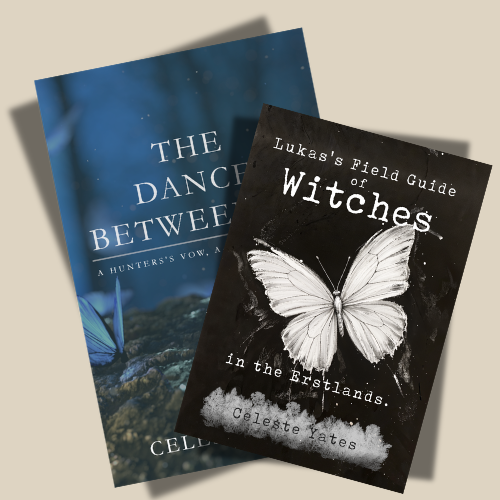
When readers dive into the world of The Dance Between Us, they are quickly introduced to the grim reality of the Order and the hunters who track what the world calls “witches.” But in the dark corners of this world, magic is a physical, demanding weight.

Through the blood-stained pages of Luka’s Field Guide, we catch a glimpse of how the Order categorizes these anomalies. At the very bottom of the hierarchy sits Tier One: The Natural Practitioners.
They are the most common, the most grounded, and perhaps the most tragic entities a hunter will ever face.
Bound by Dust and Biology
Unlike high-tier Anomalies that shatter reality or Elementals that command atmospheric fury, Natural Practitioners (formally classified as Class I or Division III threats) operate strictly within the laws of our world’s rules. They are physical entities: they follow the seasons, they require breath or water, and they cannot be separated from their immediate surroundings without suffering.
To a practitioner, magic is a circle of sustainability. If the forest burns, they burn. If the village is plagued, they gasper for air. They do not summon power from nothing; they require a physical host—blood, timber, or rot.
According to the classification logs, the entry-level tier of earthbound magic manifests in a few distinct archetypes:
- The Root Mother (Hedgewitch): Witches physically fused to living wood. They graft themselves into deep-rooted timber like Oaks or Pines, establishing a brutal biological architecture: a central Tap Root anchoring them into the bedrock, muscular Lateral Roots for physical defense, and fine Root Hairs that map the forest floor through vibration.
- The Weaver of Rot (Decay Witch): Confined to stagnant, sunless hollows and damp cellars, these practitioners accelerate the breakdown of organic matter to fuel their own spread. Where they walk, the air shimmers with a heavy “Spore Drift” and iron rusts at triple its natural speed.
- The Healer: The most deceptive of the practitioners. Often hiding in plain sight as a village herbalist, a Healer anchors herself to vitality and blood rather than soil. They utilize “The Lie” of common tea—brewing harmless cups of mint or dandelion—to mask the intense, painful magic of building a biological bridge to physically knit a patient’s flesh. (Readers of the guide will remember Martha, a master of this silent mask).
- Feral Weavers & Empaths: Smaller sub-classes that subtly compel local fauna and faerie entities, or quietly siphon the emotional energy of the communities they inhabit.
The Strategy of the Hunt: Disruption Tactics
Because Natural Practitioners are anchored to human biology, they can be countered using grounded, physical means. In the field manual sections of the guide, hunters are taught that an earthbound witch is not a hunter, but a trap—dangerous only once you step inside her radius.
To survive an encounter, a hunter relies on cold physics and chemistry:
- The Application of Salt: Drawing an unbroken line of salt around a Root Mother’s primary trunk breaks her magical flow, making her massive lateral roots brittle, sluggish, and dry.
- Quicklime (The Bone-Burner): For a Weaver of Rot, moisture is life. Casting quicklime over her fungal mat aggressively strips away the humidity she requires to expand, turning her living velvet into gray ash.
- The Burden of Exposure: For Healers embedded in towns, iron shackles are rarely needed. Simply exposing their secret to the village forces them into a cage of public fear and isolation, disabling their ability to draw environmental vitality.
Tragedies, Not Monsters
It is easy to look at a creature woven into a sprawling web of fungus or embedded in the heart-wood of an ancient forest and see a monster. But there is an underlying, grim understanding: these women were ordinary humans who simply stood too close to the “tears” in the Veil. They were stained by the outside, paying for a portion of their magic with their own humanity.
They live in cages of their own making. Alisha is trapped by the trees; Martha is trapped by her own careful silence. They are tragedies to be finished, rather than monsters to be celebrated—and for a hunter like Lukas, providing a “rattling relief” at the end of a blade is often the closest thing to a mercy this world can offer.
Want to dive deeper into the field notes? Over the next few weeks, we will be uncovering a closer look at the anatomical structures of the Root Mother and the terrifying “Puppet Networks” of the Decay Witch.
Explore the interactive world, read exclusive lore chapters, and grab your copy of The Dance Between Us.