
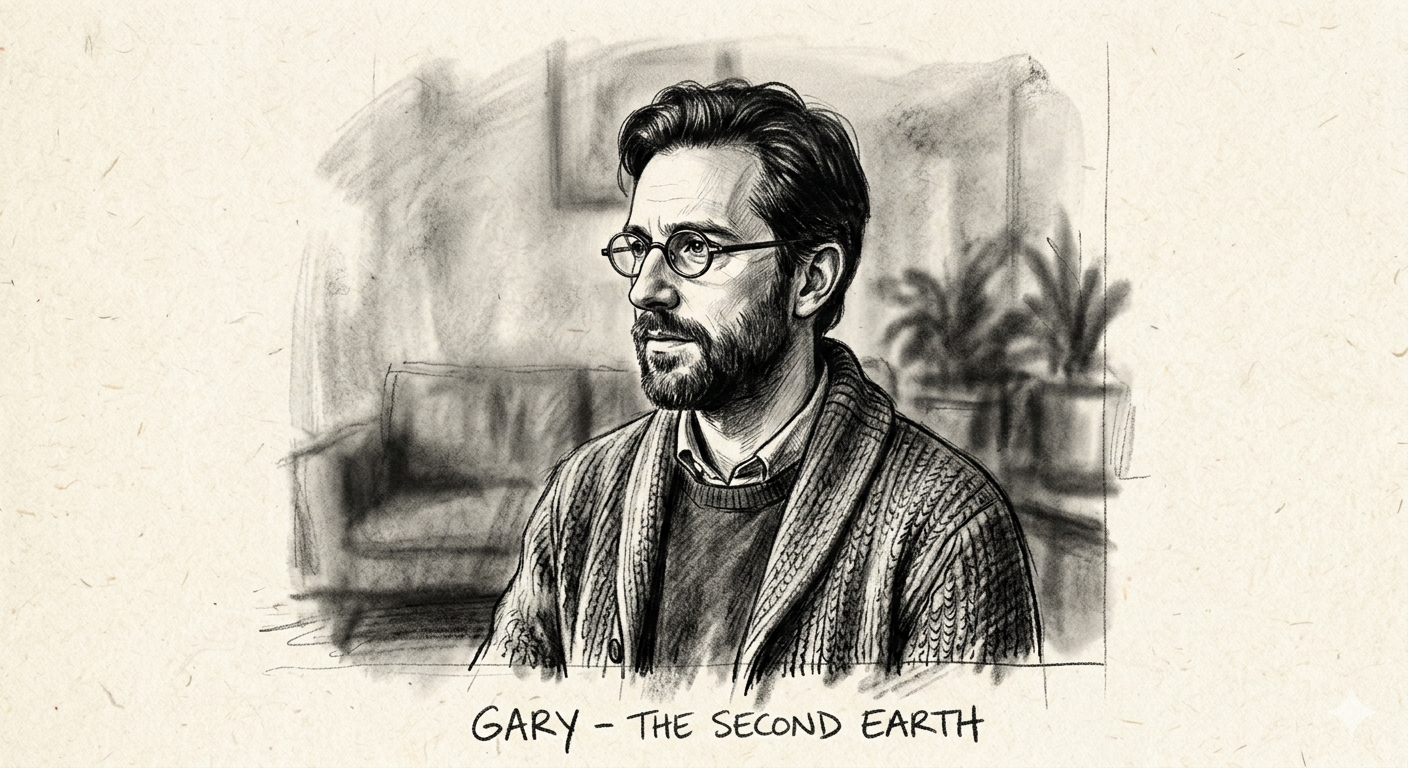
In the pantheon of speculative fiction, we are often served a binary of heroes: the wide-eyed optimist or the calculated villain. Gary, the disgruntled co-owner of the “Up Yours” eVTOL garage in Celeste Yates’s Second Earth, shatters this dichotomy. A high-ranking scientist who abandoned the hollow prestige of the government for a grease-stained workshop, Gary serves as the narrative’s indispensable realist. On a planet that is literally losing its breath—a “lump of rock” whose core is cooling into a silent tomb—Gary’s cynicism is not a defeatist trait, but a sophisticated survival mechanism. He is the man who looked at the end of a world and responded with a middle finger and a toolkit.
The “Up Yours” Philosophy
Gary’s rejection of the “Bureaucratic Bog” is immortalized in the naming of the trio’s repair shop. While Walter, the group’s meticulous sentinel, intended to register the business under the minimalist and professional name “Up,” Gary took the liberty of completing the sentiment. This act of petty defiance reflects a profound disdain for the “flock of numpties” and “pillocks” Gary left behind in government.
The registration papers provide a striking visual metaphor for Gary’s character. We see Walter’s “neat blue penmanship” juxtaposed against Gary’s “rushed, jagged penmanship.” As a “Literary Analyst,” one must see the synthesis here: Gary’s handwriting is an extension of his physical presence—a “large, clumsy type of creature.” His lack of aesthetic refinement is a byproduct of his high-velocity intellect. Gary has no time for the “neatness” of a dying administration. To him, the name is “memorable.” It is a permanent signal to the elite that he has officially opted out of their “cesspool of paperwork.”
Gary’s Realist Worldview
While the population celebrated the launch of the nanobot project as a salvation, Gary remained a “cheerful pessimist.” He possessed the intellectual honesty to see the nanobots for what they were: a temporary bandage on a “gaping chasm of denial.” His brilliance is defined by his ability to ignore symptoms and diagnose the terminal cause.

While others distracted themselves with atmospheric thinning, Gary remained fixated on the cooling core that weakened the magnetic field. His blunt assessment serves as the novel’s most impactful technical truth: “The issue at the core. Literally. The issue at the core.” By identifying the nanobot project as an “all eggs in one basket” folly, Gary positioned himself as the only character truly prepared for the “final curtain.” He understood that humanity was merely delaying the inevitable on Mars, and his “cold, sinking suspicion” eventually outpaced the state-mandated optimism of the Bureaucracy.
Clumsy Frame, Sharp Instincts: Gary in Crisis
Gary’s physical awkwardness—slamming his head on counters and bumping his knees into cupboards—is a deceptive cloak for his predatory instincts. In Second Earth, his “clumsy” nature actually serves as a catalyst for discovery. It is after a violent head-bump against a counter that Gary notices the “avian compromise” happening right outside his window. He is the first to identify the erratic behavior of the Red-Chested Jolapy and the Skymoth, realizing that these birds are flying lower due to atmospheric pressure drops.
When the crisis hits, Gary’s “broad frame” and “low growl” transform him into a literal shield for his friends. As the Sky-Hammer 4.5—a “brute-force” machine that acts as a mechanical extension of his own personality—sits idle, Gary recognizes the shift from engineering to survival. He is the one who breaks the paralysis of the group, shouting, “We move to the bunker!” During the chaotic riot at the iron gates, Gary uses his massive presence to navigate the “flock of numpties,” ensuring Walter and Kyle reach the safety of the twenty-story steel doors.
The Bond of the Trio
Gary’s loyalty is expressed through a lexicon of creative insults. To Gary, calling his best friends “over-ripe mangoes,” “plonkers,” or “pickled tits” is a sacred marker of their shared history. This trio is bound by the experience of being “pushed out” by an unethical government, and Gary’s banter is the glue that keeps them functional under the weight of extinction.
This dynamic is perfectly captured in their technical debates regarding eVTOL models. While Kyle defends the aesthetics of the Sky-Lark, Gary remains tethered to the pragmatic:
“Gary, just admit you are wrong. You know the Sky-Lark’s chassis system is heavy… she’s like a large bulldozer with four fans hot-glued on.”
“Rubbish! She is streamlined and elegant.”
“She’s a bulldozer with a tutu.”
Gary’s insistence on the Sky-Hammer 4.5—a model others might find unrefined—mirrors his own refusal to prioritize form over function. He recognizes Kyle as the “idealist” and Walter as the “meticulous” soul, accepting his role as the “clumsy” cynic who keeps their feet on the Martian soil.
Gary and the “Blocks of Life”
Gary’s ultimate evolution occurs when he transitions from a garage owner back into the scientific fold of the “Underground Brigade of Moles.” When Kyle reveals the secret rocket project designed to seed the planet Terra, Gary’s reaction is quintessentially cynical yet immediately productive. Upon hearing the project’s name, he scoffs: “Terrible name… First thing to change.” Even as the world ends, Gary is critiquing the “soft” branding of the idealists.
While Walter clings to the hope of a “patch” for Mars, Gary immediately accepts the finality of their situation. He lends his expertise to optimizing the rocket, acknowledging that their current existence has reached its end. His peculiar brand of courage—a stoic acceptance of mortality paired with a tireless work ethic—is summed up in his quiet reflection: “We’re still going to die, aren’t we?… Just not today.”
The Legacy of a “Pillock” Hunter
Gary’s journey is a masterclass in the value of the “honest cynic.” He began the narrative clapping Walter over the head with a wad of papers and ended it as a primary architect of humanity’s last-ditch effort to seed a new world. He never lost his sharp tongue or his hatred for the “Bureaucratic Bog,” but he channeled that energy into the “Underground Brigade of Moles,” ensuring that something of Mars survived the frost.
If the world were ending, would you rather be led by an optimistic bureaucrat who promises a patch that will never hold, or a “clumsy” cynic who tells you the truth while he builds the rocket to save your legacy?
