
3%. Just read that again. 3%. It’s not a lot, is it? Now think of all the people in the world… 8.3 billion people, according to the last count. 3% is 245 million.
It’s a lot of people. But it’s only, roughly, a quarter of 1 billion, and there are over 8 billion in the world. So a lot, but in the greater scheme of things, it’s not really a lot. Agree?
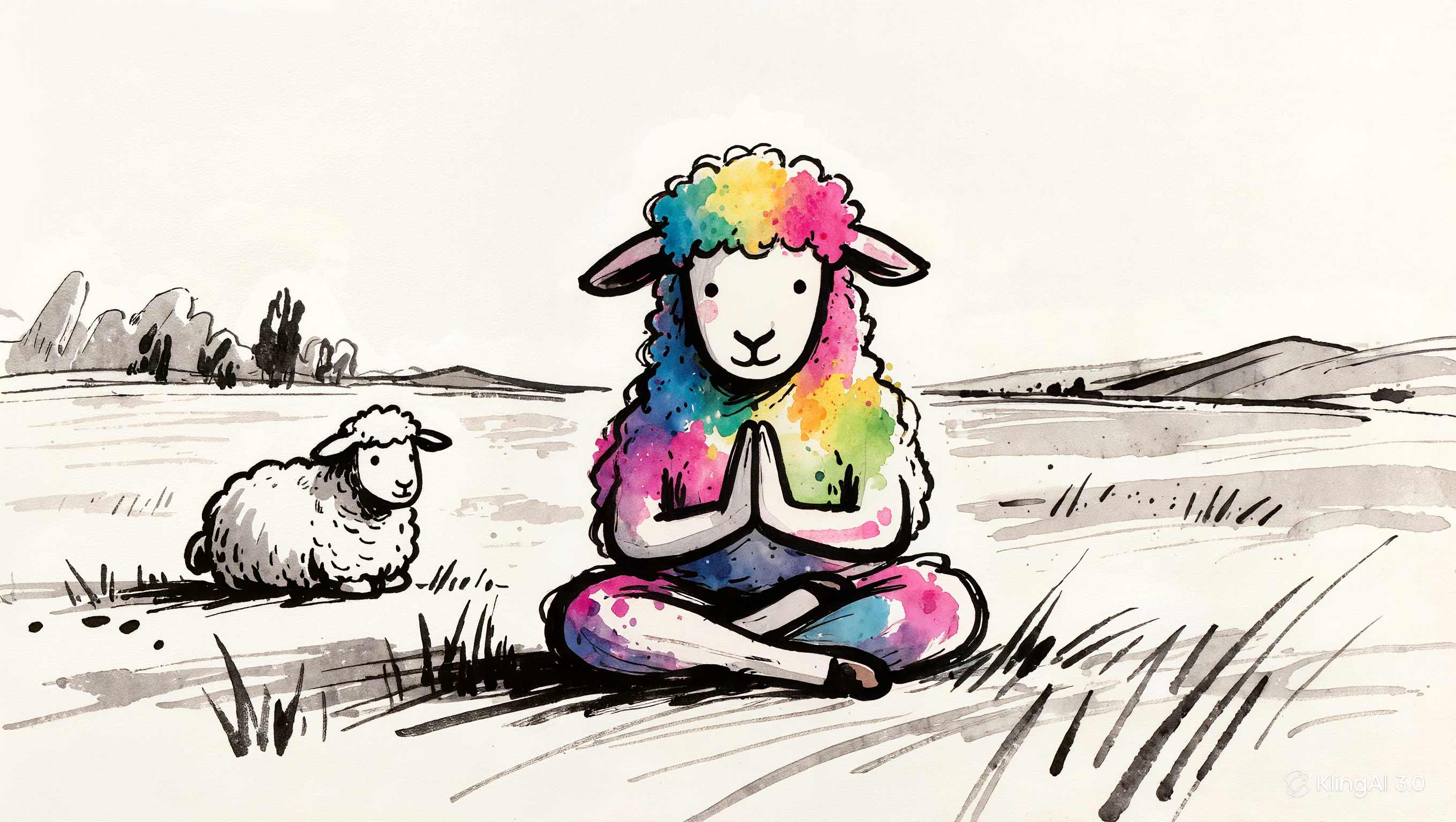
Why am I telling you, a multicolored sheep, about this? Because that’s how many there are, in the world, of you. Hyperphantasia (isn’t that a great-sounding word?) is the phenomenon characterized by extraordinarily vivid, photo-like mental imagery that rivals real-life perception. And if that’s you, then you are like me, and we make up 3% of the world. Yep – you can Google that.
Now, that begs the question, what is everyone else experiencing then? Well, it’s a bit of a spectrum, really. Some people experience some degree of hyperphantasia. Your version might be better than mine, or mine might be better than yours… we would have to compare notes. But I can tell you what I experience, and you can see how you fit in.
For me, I could be in the shower, having coffee, or writing. Location doesn’t really matter. I could even be right in the middle of the conversation, and someone will be telling me a story, and I can completely visualize it. When I write, it’s at its peak. Because I learned how to type when I was twelve, and now I am… um.. let’s say early forties… I don’t think about typing at all. I just think something in my head – a narration – and then it appears, magically on the screen, without me having to tell my fingers anything. I can even close my eyes and know when I got a typo, and backspace. It’s a crazy skill, I know. Thank you.
So what happens then? Well, I normally stare at the screen, just in case someone is watching, and I don’t want to make them feel uncomfortable… or I stare at the wall, and I become more focused on my mind’s eye.
It’s not like I don’t see what’s around me anymore, like my vision has gone out of focus; it’s more like I’m just aware of two spaces. This space, here in reality. And then another space, in my imagination, I guess.
Bear with me, this is a very weird thing to explain, and I’m hoping you kinda know what I’m talking about, else you are reading the wrong book….
If I close my eyes, it does help with distraction, but it’s not something that I have to do. I’m fine, just ‘phasing’ out.
So now I can imagine a space and what it looks like. I can smell it sometimes, if it has a pungent smell, like a swamp. But most of the time, smell doesn’t come through particularly strongly. I have to make a mental note to conjure that up. In this space, in my imagination, I can see whatever I want, in detail. I can see if it’s a birch tree, with white trunks and horizontal lines, or if it’s an oak tree, with vast branches and autumn leaves. I do find that sometimes places or certain things will look a little familiar. Like I made a mental note when I saw something in real life, and now my imagination is using that as source material. For example, when I was a kid, I used to hike up this mountain range in Cape Town, South Africa, and there used to be this amazing oak tree at a fork in the path. There was a large boulder next to it, which the tree had melted a little, and I would climb up there. If I want a tree like that, for a scene, that’s source material it uses because I have a strong memory of it, as a 3D object, including texture and smell.

My characters are also separate from me in my head. I can hear the dialogue, rather than think “what would Dave say.” Dave, in my imagination, is already a full-fleshed human who has his own accent and favorite sayings. I don’t have to think about what he says, because he simply talks.
Now, before you phone people to get the men in lab coats to bring straight-jackets to my house, I do want to say that I am fully aware this is all in my imagination. For my books, I simply run the plot line and narrate what I see, feel, hear, smell, and also emotionally feel. My fingers, which are well-trained, churn out my narration of what I am experiencing on the computer. That’s my process.
Research and prep work help keep me focused as well as give me the ability to plug in easier, but what I want to bring to light here is that, while I think I’m alone with this ability, I am not. I’m pretty sure that as a writer yourself, you might have some version of this?
It also works in reverse. I can read a book and fully disappear into that person’s world during the duration of the read.
I know my mom, who isn’t a writer, has a type of version. She can’t create a full world, but she does have comic strips and can imagine craft projects. Sometimes, her comic strip is a lot funnier than whatever she heard or saw, and she’ll laugh for days, and we have no idea what she is on about.
If you are wondering about what the ‘norm’ is for the rest of the human population, it’s just a monologue. A voice. They have an inner voice and a narration. Some don’t have a voice or video. They are working with simple visuals, like blocks, I would imagine. Or shapes. There is even a percentage (5-10%) that has nothing, which is called Anendophasia. They must be really good at meditation in yoga.
I tell you all of this because I want you to know two things. The first thing is that even if you have a little of this inner cinematic world, that makes you unique and special. It’s something you should celebrate and try to expand. Grow on it. The other thing I want you to know is that you are not alone. In the later chapters, I’m going to unpack how isolating it is sometimes to be a writer. While there are many of us, we are few and far between. I also find that when writers appear in my social feeds, I don’t like them very much. They come across as very elite-type people who nit-pick over the one sentence in a book and complain when someone shares a story that might be borderline cliché. They are intimidating and scary people who seem to get anal about Oxford commas and jump on soapboxes as soon as someone mentions 50 Shades of Grey or The DaVinci Code. At least, that’s how they come across to me.
But I am sure that is not the case with everyone. I have met people in advertising who are wonderful, creative people who share funny stories and conjure up witty remarks over a drink. They imagine the best scenarios and push the stories or punchlines to the very max, to see how much they can get out of it. I also had a conversation, once, with a musician, where all we did was a simple exchange of words beginning with the letter ‘O.’ After an hour or so, I ran out and started making up words beginning with ‘O,’ but I was very impressed that a) he tolerated me doing so and b) he still had legit ‘O’ letter words for another half an hour before he ran out.
There are different types of writers and creatives in the world. There are those who relish the classic works and love the red pen, and then there are those who enjoy the escape of it. Or the imagination – the joy of exploring spaces that don’t exist. We hear, or experience something that jars a thought loose in our head, and as we unpack it, we find plot lines, character profiles, and locations that seem to simply ‘arrive.’
And then there are those that are somewhere between those two extremes, to bridge the gap and make sure we are reminded that we all are writers and we should all get along.
So, yes… You are not alone. And you are special. And that is a good thing, because as much as I hate to say things, with the social media world having overused this phrase, but this… this magic of your inner world is a superpower of yours that you share with only 3% of the world’s population.
It also sounds super cool. Hyperphantasia. So much better sounding than the other labels out there. At least in my opinion.

Being the Multicolored Sheep
This blog post is part of a larger project – Being the Multicolored Sheep – which will be a collection of posts, research, thoughts, and insights of being a creative, eccentric writer and the challenges that come with it. It will be a conversational (as you can tell from above) book, for fellow writers to be able to know that they are not alone.
But most importantly, to feel supported. A must-have for anyone who has the self-awareness to realise they are a walking, breathing enigma to the common Dave in accounting. If you question individuals to help with your next character profile, rather than to make friends, then this is a welcome book to your tribe.