
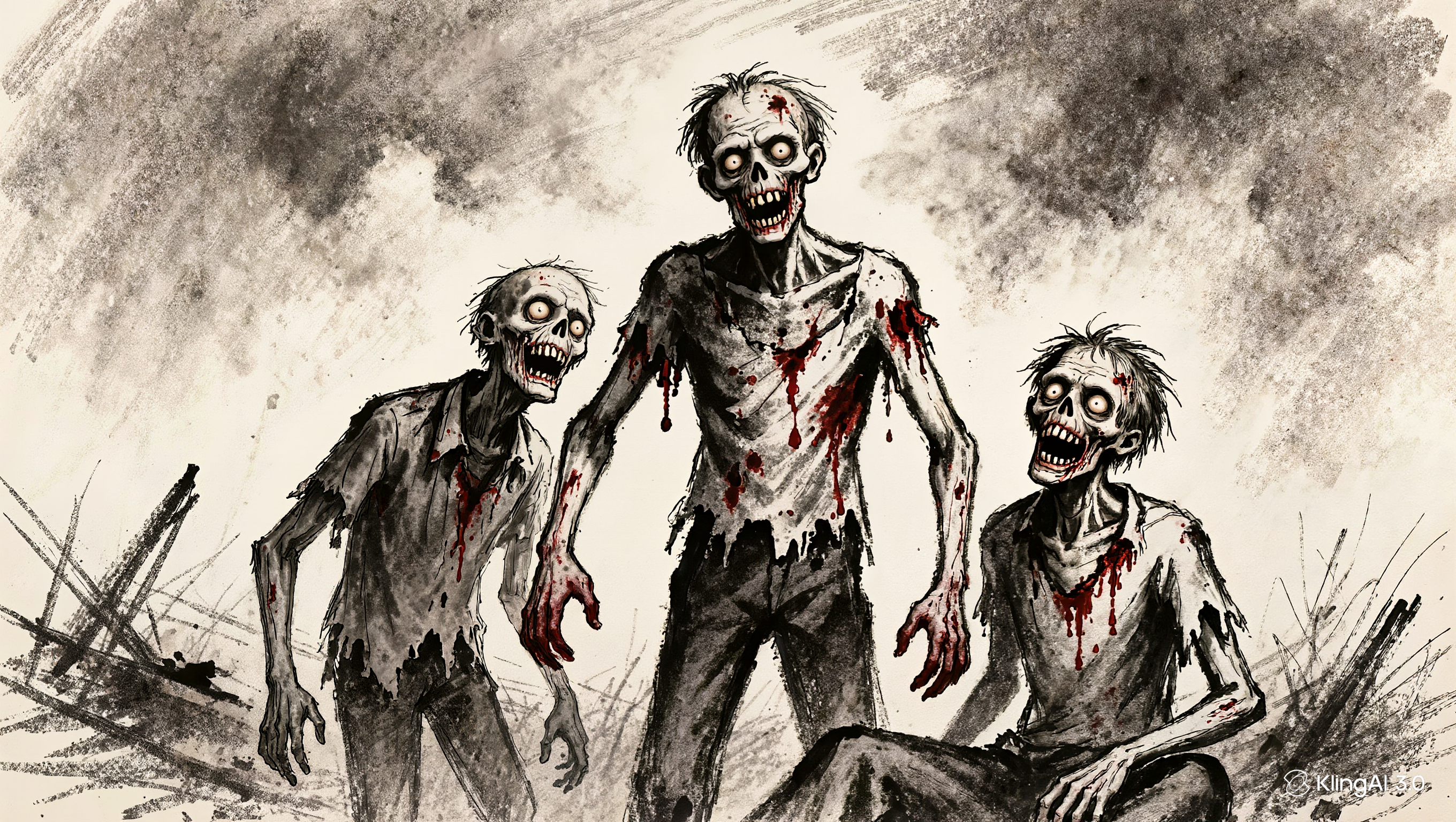
Lore for: The Duct Tape Dead
In the sun-drenched corridors of the post-war recovery, a new demographic has taken the wheel: the “fixing generation.” To the likes of Stevie—the local “Home Association” influencer—the world is a canvas for upcycling and “Mindful Meadows” aesthetics. On his TikTok feed, the grit of the Great War is a filter to be adjusted; the veterans lingering on the sidewalk are merely “house-challenged” obstacles to a trendy urban renewal.
But if you look past Stevie’s ring light, you’ll see men like Kaa. Kaa stands perfectly straight, a relic of military discipline, even as his dark, stringy hair clings to a scalp that hasn’t seen blood flow in decades. To Stevie and his client Susan, Kaa is a “vagrant” or a “floating plastic bag in the wind”—annoying, non-degradable, and best swept away by social workers. In reality, Kaa and his peers exist in a “gray zone” of non-threatening decay, hiding in plain sight. They are the chemical ghosts of a war that the fixing generation is desperate to paint over, living—or rather, persisting—in the camouflage of poverty.

When Omega Met Neurotenin
The biological tragedy of the undead didn’t spring from a graveyard; it was synthesized in a lab. During the war, military scientists developed “Compound Omega,” a serum designed to create the ultimate athlete-soldier by heightening adrenaline and muting pain. The goal was peak performance, but the reality was a catastrophic chemical collision.
The enemy deployed “Neurotenin,” a synthetic neuro-enhancer intended to scramble the senses. When these two compounds met in the veins of the front-line infantry, they didn’t cancel each other out—they created a permanent, exhausted stalemate.
“The problem is they burnt out quickly,” Dr. Carl Jansen reflects on the visceral horror of the initial exposure. “There was a frenzy of macho men and women going delirious for a few hours… engorged muscles going beyond the skin’s capability to stretch, veins bursting and exploding. And then, basically, they all dropped dead of exhaustion.”
The “Super-Soldier Paradox” is the irony of a war-winning formula resulting in a population that is neither dead nor alive, but perpetually “burnt out.” They woke up after the gas cleared, not as peak athletes, but as corpses that simply refused to stop moving.
The Drift: The Sound of Finality
Contrary to the cinematic myth of the eternal zombie, these individuals are not immortal. They are in a state of suspended, slow-motion disintegration that eventually reaches a terminal threshold known as “The Drift.” For the undead, the Drift is far more terrifying than their first death; it is the moment the chemical glue finally fails, and the “soul” is released into oblivion.
The signs of a Drifting individual are distinct and hauntingly quiet:
- The Sound: A gentle, dry scratching, much like the sound of mice behind wood or a newspaper being slowly crumpled.
- The Reaction: A brief, singular body jerk, as if the nerves are firing one final, phantom signal.
- The Aftermath: The physical form collapses into fine dust, leaving behind only the “personal object”—a pocket watch stopped at 10 a.m., a caduceus pin, or a set of worn dog tags—that the individual carried to anchor their fading identity.
The Power of a Groan
Linguists would find the communication of the Omega-Neurotenin undead a marvel of efficiency. They have stripped away the “clutter” of human speech—adjectives, adverbs, and complex syllables—creating a language of pure volume and tonal intensity.
While the “fixing generation” hears only mindless moaning, these sounds carry the weight of complex human debate. Beneath a bridge on Hertzog Blvd, you might hear a series of rhythmic groans that sound like a logic puzzle. In reality, Kaa and his friend Nee might be spending days debating the “Bear-man vs. Shark-man” hypothetical (a consensus that Bear-man wins because Shark-man lacks legs for land combat).
“Peeling back sentences to the minimal spine required for understanding is somehow more emotional and expressive than the original articulation.”
By stripping speech to its marrow, the undead communicate with a raw sincerity that makes modern human conversation seem performative and hollow.
The Hardware of Hope: The Utility of Duct Tape
Traditional medicine is a luxury of the living. Because the undead lack living cells to facilitate healing, a simple gash is a permanent structural failure. To manage this, they have established the “Rot and Repair Shop,” a clinic that feels more like a hardware store than a hospital.

Run by practitioners like Taa (who still wears her medical caduceus pin), Eve, and Daa, the shop operates out of a rusted surgery chair under a flickering bulb. Here, the tools of survival are super glue, staple guns, and, most importantly, duct tape. Maintenance is a precarious balancing act: they must move enough to stave off the absolute stiffness of rigor mortis, but not so much that they risk shattering a brittle bone. In this economy of rot, a fresh roll of silver tape is more valuable than gold; it is the only thing keeping their “being” from spilling into the dirt.
The Jansen Agenda: The Doctor Who Wants to Die
The greatest threat to these individuals isn’t the police or the social workers, but the medical ambition of Dr. Carl Jansen. Jansen suffers from a terminal diagnosis of ALS, a disease that is slowly stealing his ability to move and breathe. His obsession with the undead isn’t a search for a cure—it is a search for a transition.
Jansen views the current undead as “primitive husks,” yet he envies their necrotic longevity. He seeks to refine the Omega-Neurotenin formula to “convert over,” sacrificing his failing living body for a state of permanent, chemical preservation. The horror lies in his hypocrisy: he views his patients as specimens to be prodded in gas chambers, even as he prepares to join their ranks to escape his own fragility.
WARNING: For the chemically altered, the high radiation of Fallout Bay is the only true sanctuary. While the toxicity is lethal to humans, it acts as a radiation shield for the undead, creating a zone where unshielded doctors and their scalpels cannot follow.
The Cargo Ship Solution
As the urban landscape is reclaimed by the “fixing generation,” the undead are looking toward the horizon. Some believe in the “Zombie Seed” metaphor—that they didn’t rise from graves, but were “grown” from the chemical soil of the war. If they are seeds, they are now looking for new ground.
The ultimate goal is the “Open Ocean.” By stowing away on automatic cargo ships—vessels that run on currents and pre-programmed destinations without human crews—the undead can find a peaceful, drifting existence. On the water, they can live in repurposed containers, moving perfectly with the tides.
Whether a “soul” can truly be contained within a chemical mistake remains a question for the living. But as they move toward the coast, they carry their mourning songs with them, a reminder that they are bound together by more than just duct tape and trauma.
We groan as one, for one who’s gone We are bound together; we carry on.
