
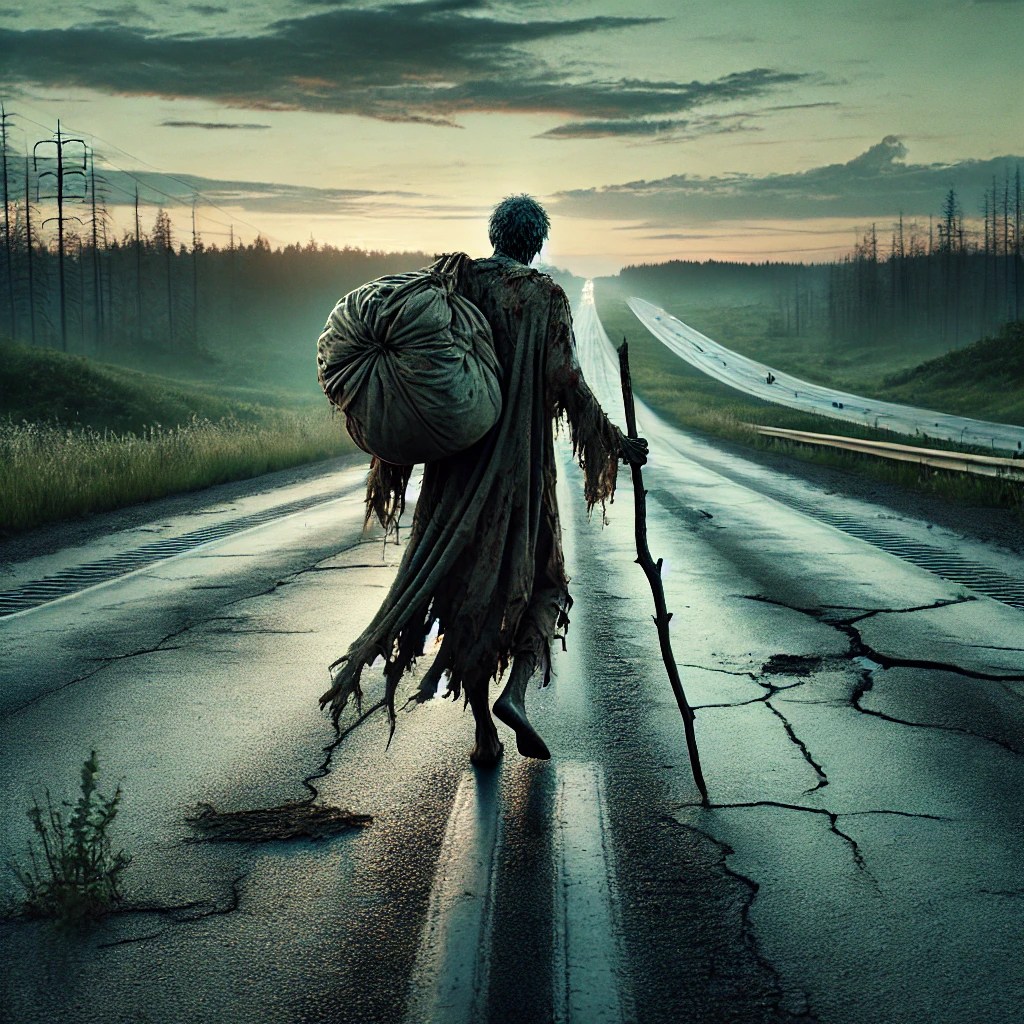
In the narrative of The Duct Tape Dead, the character of Michael—colloquially and disparagingly known as “Crazy Mike”—functions as a vocal and vigilant mirror to the protagonist zombies, Nee and Kaa. Residing in a precarious tent city beneath the Hertzog Blvd bridge, Mike represents the primary source of external narrative tension, existing in a state of liminality between the “civilized” human world and the “grey zone” inhabited by the undead.
Unlike the broader human population that treats the zombies with social invisibility, Mike is the only observer who perceives their true nature. As the narrator observes, Mike presents a constant threat to their anonymity because he “keeps trying to tell the other humans that we are zombies.” His role is initially antagonistic, yet his paranoia serves as the first acknowledgement of the zombies’ lingering humanity, albeit through a lens of terror.
Core Traits and Survivalist Quirks
Before his biological transformation, Mike’s character is defined by a frantic, survivalist energy rooted in social neglect and mental instability. His presence provides a layer of thematic irony; while he fears the “monsters,” the monsters find his behavior both humorous and absurd. His defining traits include:
- Heightened Paranoia: A conviction that he is the intended prey of a zombie uprising, leading to a refusal to interact with the undead except through defensive outbursts.
- Persistent Insomnia: A desperate refusal to sleep, predicated on the belief that unconsciousness equals vulnerability.
- Mythological Confusion: The adoption of misguided protection methods, frequently conflating various folkloric traditions to ward off the protagonists.
This absurdity is best captured in Mike’s desperate attempts at spiritual warfare:
Mike waves a “garland of garlic” to ward off the zombies, a gesture more suited for a vampire hunt than an encounter with the war-decayed dead. The zombies, observing with a dry sense of humor, describe him as “shrieking like a pork belly pig” before he retreats into the relative safety of his tent.
Discarded by Society
The pivotal scene of Mike’s marginalization occurs during the police raid on the bridge. This moment crystallizes Mike’s “social invisibility,” as the authorities refuse to distinguish him from the “non-threatening, but embarrassing” marginalized group he lives alongside. His frantic dialogue—”I know what you are!” and “I got my protection on!”—is dismissed as the ramblings of a vagrant.
Crucially, the narrative contrasts Mike’s gritty reality with the “aesthetic generation” represented by characters like Stevie and Susan. To influencers like Stevie, who promotes “Mindful Meadows” while filming the “house challenged” for social media engagement (“Hey-yaa!”), Mike is merely a prop or an obstacle to gentrification. When Mike screams “I’m human!”, he is met not with rescue, but with handcuffs. This betrayal by his own species demonstrates that society had “Othered” Mike long before he was ever subjected to medical experimentation.
The Driftwood Facility: A New Perspective
Upon his institutionalization at the Driftwood Behaviour Facility, Mike’s character arc shifts from frantic paranoia to a profound, shared empathy with the zombies. Removed from the immediate “grey zone” and placed under clinical observation, Mike reflects on the shared history under the bridge with a clarity that was previously absent.
He realizes that while humans like Stevie viewed him with disgust, the zombies “never had a problem” with him and even “helped [him] with [his] tent a few times.” This realization serves as the emotional anchor of the study: Mike discovers that the zombies’ “mourning ritual”—the haunting, rhythmic song they perform for those lost to the “Drift”—possesses a “raw and more human” empathy than the clinical indifference of the Driftwood staff. He begins to see the zombies not as monsters, but as a community of the discarded, far more compassionate than the world that institutionalized him.
The Final Transformation: Subject H03
The transformation of Mike into “Subject H03” is a transition into a “post-post-mortem” state, orchestrated by the cold, clinical ambition of Dr. Jansen. Jansen, seeking a cure for his own ALS, utilizes Mike as a biological canvas for his father’s war-era research. The experiment involves a traumatic combination of:
- Compound Omega: A blood-altering gas that targets cellular oxygen.
- Neurotenin: A synthetic neuro-enhancer designed to bridge the gap between death and animation.
The physical horror of this process is absolute; the narrative describes Mike emitting a “non-human scream,” followed by a chilling “flatline” on the medical monitors. In this moment, Mike ceases to be a human observer. His “eyelids flicked open” while his pulse remained non-existent, marking his entry into a biological peerage with the very creatures he once feared.

The Great Escape
In the climax of the narrative, Mike’s role is redefined from a paranoid antagonist to a vital, albeit traumatized, asset. During the rescue at Driftwood, Mike—now H03—is found “dosed and unaware,” a creature of deep trauma rather than a rational volunteer. His inclusion in the escape is a necessity born of communal debt.
While he is “dull-eyed” and initially passive, Mike provides a functional role that the decaying zombies cannot: he is the driver. The group’s reliance on Mike is summarized in their simplified directives:
- The Rescue: The group recognizes him as a victim of “fucked up” human malice.
- The Asset: He possesses the motor skills required for complex machinery (“You… vroom vroom”).
- The Shared Fate: Having been subjected to the same biological trauma, Mike can no longer return to the world of the living.
The Human/Zombie Hybridity
Mike’s arc from “Crazy Mike” to Resident Ally is a masterpiece of thematic irony. He begins the narrative as a man terrified of losing his humanity to the monsters under the bridge, only to eventually find his truest community among them. His transformation into Subject H03 represents the final erasure of his “legal” humanity, yet it is through this loss that he escapes the social invisibility and clinical cruelty of human society.
Mike serves as the bridge between two worlds: the human world that discarded him as an embarrassment and the zombie community that accepted him with raw empathy. Ultimately, Mike’s journey suggests that in a world obsessed with aesthetics and renewal, the only place left for “raw” humanity is in the radioactive ruins of Fallout Bay, where the discarded can finally drift together.
