
You often hear about people doing great and grand things when they have no one else to worry about, other than themselves. Every generation of women has had some type of role model in the form of a woman who moved overseas, leaving children and partners behind, to, on a whim, experience some exotic location and then decide to live there.
My mother’s generation had it in Shirley Valentine – a quirky 42-year-old who spoke to walls and moved to Greece to fall in love with life. The generation between my mother and me had Under the Tuscan Sun, a tale of a recently divorced woman who is convinced to go on a holiday to Tuscany and ends up buying property there at the last minute. Her story is a bit more focused on trying to find a partner, and then realizing that she’s OK on her own. So, of course, that’s when he shows up.
And then, in more recent years, we had Elizabeth Gilbert’s Eat, Pray, Love. A tale that also starts off with divorce and ends in romance, after eating a lot of pasta and then learning to let things go.
Now, these are far from biographies, but they do center around the idea that change is necessary in order for ‘new’ to come in.
Jane Austen is, of course, a great example. Unlike many of her peers, in an era where women depended on men, she, instead, made her way through life as a writer. J.K. Rowling is a more modern example. She was divorced, a single mom, living on the state benefits when (and I’m quoting here)
“I was going by train from Manchester to London, sitting there, thinking of nothing to do with writing, and the idea came out of nowhere, and I could see Harry very clearly; this scrawny little boy, and it was the most physical rush of excitement. I’ve never felt that excited about anything to do with writing.”
These, of course, are all female writers. But it’s not a ‘guy/girl’ thing. Charles Dickens had a ‘messy’ separation after 22 years of marriage and ten children, which then, afterwards, resulted in ‘Great Expectations.’ Hans Christian Andersen, who wrote the children’s fables, also had a life of solitude, similar to Jane Austen. Then, H.P. Lovecraft conjured up his Cthulhu Mythos after his marriage.
Now that doesn’t mean you have to go and get divorced, or cancel your wedding. It just means that often, writers tend not to be very good at creating boundaries. There are plenty of writers who are married and have managed to write. But it’s because they kept that space alive and maintained, even when they shared their life with another.
So, how did they do that? Well… I’m probably not the best person to answer that, as I’m writing this to you, post-divorce! But, on the other hand, maybe I am the best, because I know exactly where it was that I went wrong.
I think the first thing you need to be aware of is that what you do is very scary for a lot of people. As mentioned in the first chapter, being fictional and conjuring up worlds, people, and plot lines is so different from the average person’s life that they just couldn’t imagine doing that themselves. They would feel judged, petrified when rent was due, and colorful from the rest of the grey corporate world. Marrying these people does mean that you need to be very aware of not letting their fear influence you. It’s a terrible, terrible brave thing, being creative, without someone next to you, freaking out. You already have to contain your own anxiety. You don’t want to take on someone else’s as well.
The next thing you need to remember is priorities. A lot of writers have problems with procrastination. I’m lucky, in the sense that I don’t, but it is still very easy to forget to hit that word count when you’re goggling over your phone every time someone new messages you. By all means, lose yourself in your honeymoon for a month or two, but always return back to your writing or creative work. It’s what keeps you centered.

A few ideas to get you started on ensuring that you keep your writing time carved out of your life are to set up a schedule.
For one year, I had a full-time job (8 hours), I home-schooled my eldest (7 hours), and then still had to fit in making supper, folding laundry, and ‘life.’ It wasn’t an easy year. I’m not going to lie to you. It was stressful. But I was able to do it because I was forgiving with myself and also understanding of what really matters. Friends that needed my attention, and constantly bothered me even when I asked them not to during really tough weeks, chucked out. I don’t need that. Writing? That comes in. I might not be able to do it every day, and that’s fine. If I just ensure my socials are scheduled around my writing, then that’s perfect.
But I made sure I had an hour during lunch to dedicate to it, or an hour before work, or an hour before bed. And I gave myself time on the weekend. If I didn’t write, because I used that time to recharge my sanity and drink tea while binge-watching. That’s OK. Try again tomorrow. The point is, you make it a priority. You give yourself the time. You try. You give yourself the best shot of being able to do it. Align yourself as best you can.
There is a great corporate buzz at the time when I wrote this, that a lot of people go to work and simply ‘react.’ They react to emails, Slack, or Team messages. They react to meetings. But they never make time for the actual things they are meant to do for their job. So, of course, come review time, and they look at their goals, rocks, or milestones, and they haven’t actually done anything. There are a lot of things that corporate people get up to that is complete nonsense, but this is actually something that can be useful to your own life.
Instead of reacting to your kid’s extracurricular activities, or reacting to invites to parties (I don’t know what stage of life you are in – maybe it’s a mix of both!), rather think ‘what is it that you need to do’ first. And then that other stuff can fit around it.
Some people do this naturally. I know a handful of people who do, and I always look at them in awe. The negative is that those people are often called ‘self-centered. Which, I mean, if that’s the case, you’ve gone too far. But still, there is something to be learned from the self-centered folks. They have boundaries. They do what they want. And while doing that all the time isn’t great, doing it enough for you to have time to write is a lesson well learned.
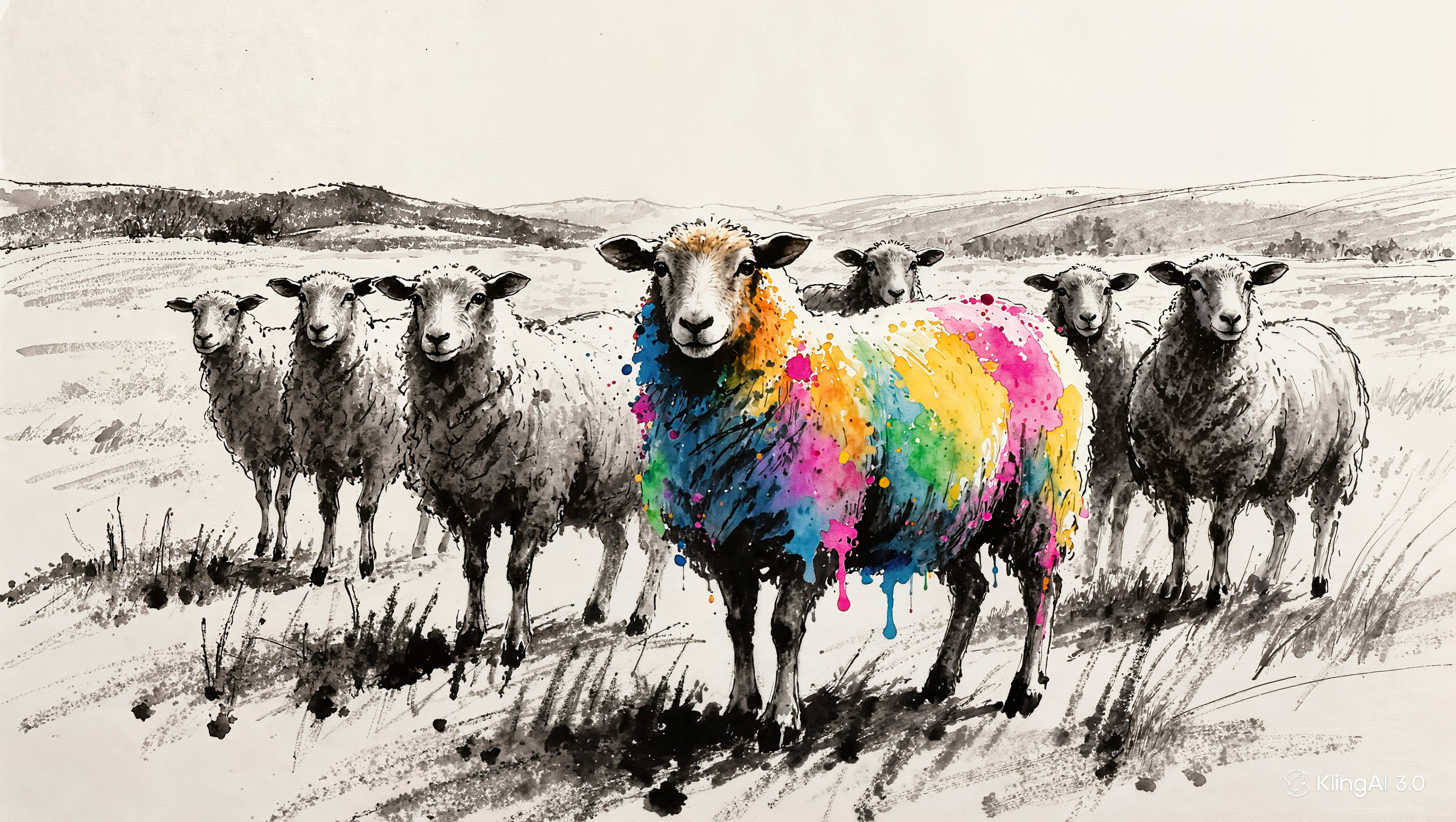
So, push back, where you need to, to make sure that you stay on your quest or side question of being an author, or a painter, or an amazing art director. Whatever it is that keeps your multicolored sheep soul happy.

Being the Multicolored Sheep
This blog post is part of a larger project – Being the Multicolored Sheep – which will be a collection of posts, research, thoughts, and insights of being a creative, eccentric writer and the challenges that come with it. It will be a conversational (as you can tell from above) book, for fellow writers to be able to know that they are not alone.
But most importantly, to feel supported. A must-have for anyone who has the self-awareness to realise they are a walking, breathing enigma to the common Dave in accounting. If you question individuals to help with your next character profile, rather than to make friends, then this is a welcome book to your tribe.
Want to be notified when it becomes available?
Fill out the form below and it will send me a direct email – it won’t add you to a list, or sell your details to the sketchy character on the corner – it will come to me to keep safe and then can send you a personal email with a link when the book is ready.

